
The EV Fastener Revolution: Market Trends, Material Innovations, and the Impact of Gigacasting 2025-2034
The Structural Transformation of Automotive Fastening: Navigating the Shift from Internal Combustion to Battery Electric Architectures
The global industrial fasteners market is currently situated at a critical juncture, driven by a profound architectural shift within the automotive sector. As the industry transitions from the mature paradigms of internal combustion engines (ICE) to the burgeoning requirements of battery electric vehicles (BEV), the fundamental engineering of mechanical joining is being redefined. In 2024, the global industrial fasteners market was valued at USD 124.2 billion, with projections indicating a rise to USD 173.8 billion by 2034, representing a compound annual growth rate (CAGR) of 3.4%. Within this broader market, the automotive segment accounts for approximately 30% of total demand, a position it is expected to maintain as it grows at a CAGR of 3.9%. However, the subset of fasteners specifically engineered for electric vehicles is expanding at a far more aggressive pace, with a CAGR of 11.6% projected between 2025 and 2030, potentially reaching a valuation of USD 20 billion by the end of that decade. This transformation is not merely a change in the volume of parts but a fundamental shift in the material science, electrical functionality, and structural integration of the fastening elements themselves.
The Economic and Regional Landscape of Automotive Fastening
The growth of the automotive fastener industry is inextricably linked to the rapid adoption of electric vehicles, which has created a massive demand for specialized, high-performance solutions. In North America, the market is characterized by rapid industrialization and high e-vehicle adoption rates, particularly in the United States and Canada. Meanwhile, the Asia-Pacific region is emerging as the fastest-growing geographical hub, bolstered by the expansion of EV manufacturing ecosystems in China, India, and South Korea. For instance, the Indian automotive sector has seen significant localization efforts, underscored by Fontana Gruppo’s acquisition of a 60% stake in Right Tight Fasteners in early 2025 to bolster its presence in the region.
The market dynamics are further complicated by external economic factors, such as inflation in major economies like the U.S. and the EU, which has driven up raw material costs and squeezed profit margins for manufacturers. Despite these challenges, the “Tesla Effect”—a phenomenon where major automakers and their suppliers gravitate toward regions with established EV infrastructure—is reshaping global supply chains, with Mexico increasingly positioned as a vital hub for innovation and precision fastener manufacturing.
| Market Attribute | 2023/2024 Value | 2030/2034 Projection | Projected CAGR |
| Global Industrial Fasteners | USD 124.2 Billion (2024) | USD 173.8 Billion (2034) | 3.4% |
| EV Fastener Market | USD 9.3 Billion (2024) | USD 20.0 Billion (2030) | 11.6% |
| Automotive Segment Share | 30.0% (2024) | N/A | 3.9% |
| Cumulative EV Sales Opportunity | N/A | USD 97.58 Billion (2025-2030) | N/A |
| Asia-Pacific Fastener Growth | N/A | N/A | 7.62% (2025) |
Architectural Disruption: ICE Complexity vs. EV Simplification
The transition from ICE to EV represents a paradox for the fastener industry. On one hand, the drivetrain of an electric vehicle is radically simpler than that of its combustion counterpart. A traditional ICE drivetrain contains between 200 and 2,000 moving parts, each necessitating specific fasteners to withstand the mechanical stresses of reciprocating motion, high-temperature combustion, and vibration. These components include pistons, connecting rods, camshafts, and complex transmission gears, all of which rely on high-strength threaded fasteners to maintain integrity under extreme operational loads. In stark contrast, an EV drivetrain typically contains only 20 to 25 moving parts, primarily limited to the electric motor, bearings, and reduction gears.
This mechanical simplicity translates into significantly lower breakdown rates for EVs. Data from the Allgemeiner Deutscher Automobil-Club (ADAC) indicates that EVs built between 2020 and 2022 had a breakdown rate of 4.2 per 1,000 vehicles, whereas combustion vehicles experienced 10.4 breakdowns per 1,000 vehicles. For example, the Toyota C-HR, an ICE model, recorded 63.1 breakdowns per 1,000 vehicles, while the Tesla Model 3 achieved a remarkably low 0.5.
However, the reduction in drivetrain parts does not equate to a lower total fastener count for the entire vehicle. While the engine and transmission require fewer bolts, the introduction of a massive battery pack—often weighing several hundred kilograms—requires a high density of specialized fasteners to ensure structural rigidity and safety. Estimates suggest that while fasteners may represent only 1% of a vehicle’s budget, they can account for nearly 50% of the total part count in a modern EV. The modularity of battery systems, high-voltage wiring assemblies, and advanced thermal management circuits necessitates an increased number of application-specific fasteners per vehicle.
Material Evolution and the Lightweighting Mandate
The primary engineering challenge for EVs is the significant mass of the battery system. To offset this weight and maximize the vehicle’s driving range, manufacturers are aggressively pursuing lightweighting strategies through material substitution and design optimization. Reducing a vehicle’s body weight by 100 kilograms can lower energy consumption by approximately per 100 kilometers, a critical metric for EV performance.
The Shift Toward Advanced Alloys and Polymers
Traditionally, the automotive fastener industry has been dominated by steel. While steel remains a leading material due to its high tensile strength and established manufacturing processes, its growth is being outpaced by lighter alternatives. Aluminum alloys, with a density of compared to steel’s , are increasingly favored for structural components and battery enclosures due to their favorable strength-to-weight ratio and excellent thermal conductivity. Magnesium alloys, even lighter at , offer mass reduction potentials of 30-70% compared to traditional materials, although they require more complex engineering to manage their unique mechanical properties.
| Material | Density (g/cm3) | Mass Reduction Potential | Primary Application in EVs |
| Advanced High-Strength Steel | 7.8 | 15-25% | Safety Cages, Impact Rails |
| Aluminum (6000/7000 Series) | 2.7 | 30-60% | Body Panels, Battery Trays |
| Titanium Alloys | 4.5 | 40-55% | High-Performance Fasteners |
| Magnesium Alloys | 1.8 | 30-70% | Interior Structures, Brackets |
| Carbon Fiber Composites | 1.5 | 50-70% | Structural Enclosures |
| Engineered Plastics | 1.0 – 1.4 | High | Non-Structural Clips, Insulation |
Plastic is projected to be the fastest-growing material type in the EV fastener market between 2025 and 2030. Beyond weight savings, polymers offer inherent electrical insulation, which is vital in high-voltage environments, and superior corrosion resistance. Fastener manufacturers like TR Fastenings have responded by launching products specifically designed for plastic assemblies, such as the Plas-Tech 30-20 screw, which provides high performance in lightweight composite structures.
Galvanic Corrosion and the Need for Specialized Coatings
The use of multi-material architectures—where aluminum or carbon fiber components are joined to steel frames—introduces the risk of galvanic corrosion. When dissimilar materials are in contact in the presence of moisture, a localized electrochemical reaction can occur, compromising the integrity of the fastener. To mitigate this, EV manufacturers are adopting advanced plating and coating finishes. Stainless steel, titanium, and aluminum fasteners are often selected for their natural corrosion resistance, but even these are frequently treated with specialized barriers to ensure longevity in harsh environments.
The New Epicenter: Fastening in Battery Pack Assembly
The battery pack has emerged as the most technologically demanding area for fastener engineering. Unlike traditional engine components, battery assemblies require hardware that simultaneously provides mechanical strength, thermal management, and electrical insulation.
Critical Fastener Types in Battery Systems
- Compression Limiters: These are non-threaded inserts designed for use in plastic or composite battery housings. They protect the plastic substrate from the compressive loads applied during fastening, preventing “creep” or cracking over time and ensuring a consistent clamp load throughout the vehicle’s life.
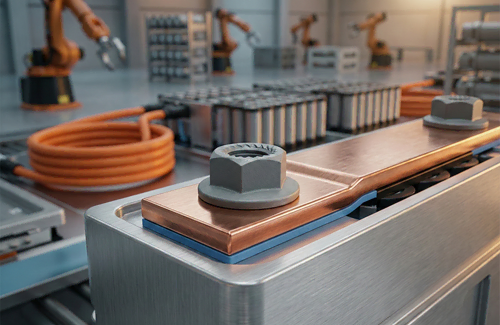
- SEM Screws and Busbar Assemblies: High-voltage joints, particularly busbars made of copper or aluminum, use SEM screws—pre-assembled bolt and washer combinations. Conical washers are utilized to prevent the loss of clamp load caused by thermal fluctuations during rapid charging cycles, while flat washers prevent the bolt from embedding into soft copper surfaces.
- Rivet Nuts and Clinching Fasteners: For thin-sheet materials like aluminum battery covers, self-clinching fasteners and high-strength rivet nuts are essential. These provide strong, reusable threads without the need for welding, which can cause thermal distortion in sensitive electronic assemblies.
- Grounding Fasteners: EVs utilize specialized rivet nuts and studs as grounding points to safely discharge electricity from the vehicle. Millions of these are used annually to ensure that high-voltage systems do not pose a risk to passengers or other electronic control units (ECUs).
Thermal Management and Dielectric Requirements
The heat generated during the operation and charging of an EV battery can be extreme. If heat is not properly dissipated, it can transfer through fasteners to sensitive lithium-ion cells, potentially leading to thermal runaway. Aluminum fasteners are increasingly used in conjunction with dedicated heat sinks to facilitate heat dissipation.
Furthermore, the high-voltage architecture of modern EVs—often operating at 400V to 800V—requires robust electrical insulation. Fasteners must now contend with dielectric requirements to prevent arcing and short circuits. Specialized dielectric powder coatings, such as Axalta’s Alesta e-PRO FG Black and Dielectric Gray, have been engineered to provide thermal stability up to while offering insulation resistance exceeding . These coatings undergo rigorous testing, including “Hi-Pot” (high potential) testing and “Holiday” testing, to detect microscopic voids or pinholes that could lead to electrical failure.
The Disruptive Impact of Gigacasting
Perhaps the most significant threat to the traditional fastener volume is the rise of gigacasting, a manufacturing process pioneered by Tesla. Gigacasting utilizes massive, high-pressure die-casting machines to produce large, single-piece structural components, such as front or rear underbodies, replacing dozens of individual stamped and welded parts.
Quantifiable Reduction in Fastener Volume
The impact of gigacasting on part count is staggering. In the Tesla Model Y, the implementation of front and rear gigacastings eliminated more than 350 stamped steel parts, including numerous brackets and joining elements. Ford expects its Universal EV Platform to utilize gigacasting to achieve a 25% reduction in fasteners compared to typical vehicle architectures. Rivian’s next-generation R2 platform is projected to eliminate more than 300 joints through similar large-scale structural castings.
| Automaker | Implementation Area | Parts/Joints Eliminated | Fastener Reduction |
| Tesla (Model Y) | Front/Rear Underbody | >350 Stamped Parts | Significant |
| Ford (Universal EV) | Structural Platform | 20% Reduction in Parts | 25% Reduction |
| Rivian (R2 Platform) | Main Chassis | >300 Joints | High |
| Xiaomi (SU7) | Underbody | 72 Components into 1 | Significant |
The Paradox of Specialized Needs
While gigacasting reduces the total number of fasteners, it creates a new market for specialized inserts. Large castings often lack the inherent thread strength needed for mounting sub-assemblies. This has led to the adoption of products like “CastSert”—threaded inserts designed to be pushed into “as-cast” holes where they cut their own threads. Furthermore, the need for rapid cycle times on automated assembly lines has driven the development of press-fit spiral fasteners, which can be installed in less than a second, compared to the several seconds required for traditional threaded bolts.
Adhesives vs. Mechanical Fasteners: The Shift to Hybrid Joining
The push for lightweighting and multi-material integration is also favoring the use of structural adhesives over traditional mechanical fasteners. Unlike bolts or rivets, which create point loads and stress concentrations, adhesives distribute loads evenly over the entire bonded surface.
Advantages of Adhesive Bonding
Structural adhesives offer several advantages in the context of EV manufacturing:
- Uniform Stress Distribution: By eliminating stress risers at drill holes, adhesives allow for the use of thinner, lighter substrates without the risk of material tear-out.
- Continuous Sealing: Adhesives provide a permanent seal against moisture, which is critical for preventing galvanic corrosion in multi-material joints.
- Vibration Damping: Adhesives act as a structural “lubricant” and insulator, reducing noise, vibration, and harshness (NVH) levels, which are more perceptible in the quiet interior of an EV.
The Prevalence of Hybrid Joints
Despite the benefits of adhesives, they are rarely used in total isolation for structural joints. Adhesives require surface preparation and curing time, which can slow down production lines. Consequently, many manufacturers use a “rivet-bonding” or “weld-bonding” approach. In these hybrid joints, mechanical fasteners like self-piercing rivets (SPR) or flow drill screws (FDS) provide immediate handling strength and peel resistance, while the adhesive provides long-term structural integrity and sealing.
Case studies demonstrate the efficacy of these new bonding solutions. A study by DuPont highlighted that custom-formulated adhesives like BETAMATE™ and BETAFORCE™ significantly improved the torsional stiffness and crash durability of a German luxury EV sedan’s battery pack. Similarly, DBMR reported that a novel structural adhesive with a lower curing temperature increased the fatigue life of automotive components by 20%.
Managing High-Frequency Vibration and Torque
The vibrational profile of an electric vehicle is markedly different from that of a traditional ICE vehicle. Internal combustion engines produce vibrations at relatively low frequencies, typically evaluated up to . In contrast, the permanent-magnet synchronous motors (PMSM) used in electric powertrains generate high-frequency noise and vibration ranging from to .
Specialization in Vibration Resistance
These high-frequency vibrations, coupled with the instant torque delivery of electric motors, can cause standard fasteners to loosen over time. This has led to the development of vibration-resistant designs:
- Wedge-Locking Fasteners: These utilize cam-faced washers that create a wedge effect, ensuring the fastener cannot rotate loose even under extreme dynamic loads.
- Thread-Locking Adhesives and Patches: Fasteners are increasingly treated with pre-applied polyamide patches (PFB) or micro-encapsulated chemical thread-lockers that provide a secure hold for up to five removal/reuse cycles.
- Structural Fasteners with High Shear Strength: Safety-critical chassis and powertrain mounts now utilize fasteners with enhanced shear and tensile strength to maintain clamping forces under the aggressive acceleration and cornering forces typical of performance EVs.
| Feature | ICE Requirement | EV Requirement | Fastener Response |
| Vibration Profile | Low-frequency (~100 Hz) | High-frequency (1-10 kHz) | Wedge-locking, Thread-lockers |
| Torque Delivery | Gradual | Instantaneous | Higher Class/Grade Hardware |
| Thermal Load | Combustion heat | Electrical thermal cycling | Conical Washers, Al-Fasteners |
| Environmental | Oil/Fuel exposure | Road salt/Galvanic risk | Advanced Coatings, Stainless |
Smart Manufacturing and the Future of Fastening
As the automotive industry moves toward Industry 4.0, the fastener is becoming a data point. “Smart fasteners” equipped with sensors for real-time monitoring of joint integrity and predictive maintenance are transitioning from aerospace into the automotive sector.
Digital Integration and Traceability
In modern “Gigafactories,” automated fastening systems are integrated with position-tracking technology to ensure that every fastener is installed in the correct location with precision often exceeding . These systems can document the exact torque applied to every joint, creating a complete “digital twin” of the vehicle’s assembly. This level of traceability is essential for meeting the stringent safety standards of high-voltage battery production and for managing post-delivery service requirements.
Sustainability and the Circular Economy
The focus on sustainability in 2025 and beyond is driving the adoption of circular economy practices. Fasteners are being designed for easier disassembly to facilitate the recycling of modular battery packs at the end of their lifecycle. “Debond-on-demand” adhesives are also being developed, which allow for non-destructive disassembly when heat or a specific chemical trigger is applied. This shift ensures that even as vehicles become more complex, the materials within them—including the fasteners—can be recovered and reused.
Conclusion
The impact of electric vehicles on the fastener industry is profound, representing a transition from commodity-scale hardware to high-precision, multi-functional engineering. While the reduction in moving parts within the drivetrain poses a threat to traditional high-volume fastener categories, the emergence of the battery ecosystem, the necessity for lightweight materials, and the demand for high-voltage safety provide substantial growth opportunities. Manufacturers that embrace specialized alloys, advanced dielectric coatings, and digital integration are poised to thrive in this new era. The “Tesla Effect” has not only accelerated the adoption of technologies like gigacasting but has also forced a reimagining of the supply chain, moving it toward a more localized, responsive, and innovative model. As the automotive industry continues its journey toward full electrification, the humble fastener will remain an “unsung hero,” evolving to meet the demands of safety, efficiency, and sustainability.
Share This Story, Choose Your Platform!